At the very beginning, there was Ratopia. Then, there's ratology. In ratology, we observe whether psychotic and neurotic people could amount to something. Then came the spinal disc herniation and impingement, bringing forth the stage of physical disability. Could someone like me go anywhere or amount to anything is the question. After the official ending of the second psychotic episode lasted for five years, I am ready to move on to the next phase of Ratology- as the solutions unfold.
My head is wacko and I bow in front of the mental God.
One principle in my life is to entertain no nothing supernatural--especially I talk with God or Gods everyday and channeling with whatever I could channel with all the times.
Red alert! Add meds! You'd say.
I don't know that? I do. Except side effects kill me as much as the symptoms themselves. Catch 22.
After 2-3, whatever, years of daily writing and rewriting for the rewrite of the original book completed with far too many words in a volume, I finally dragged myself to the final chapter.
Then, suddenly, stop was the command issued by my cuckoo head.
I dived into the sea of natural science for the layperson ... astronomy, particle physics, neuroscience, etc.
Why does a layperson forsake the comfort of familiarity and step into the foreign domains?
My crazy head told me there were at least two reasons ....
I sound like a broken record to myself because I can come up with no nothing new with what's in my bandwidth. Learn something fundamentally new just as what some, if any, will do when reading my psychotic model book.
More importantly, time to be really grounded. Since the catch 22 is blatantly laughing at me in my face, science is where I have to ground myself so that I don't get pulled into the gravity free world of my alternative reality.
Yes.
Science or STEM is very important whether it has anything to do with what you do for a living or not.
(Come to think about it, what do I do for a living? lol)
It always saddens me to see or hear people going through ever worsening psychotic episodes.
Though I am and have tried my best with limited my words, I know what I have done so far is so--simply nothing.
I had tried to let someone going through the onset know that the scary crowd that wouldn't stop judging her, what she was experiencing, didn't exist outside her reality. But it didn't help and it simply had to flow through its natural course.
I have heard of stories many a time... stories of how people didn't make it through a major episode (with my empirically tested guess). In their stories I would see the ghost of my past and life in the present.
How I wish to build a great wall to stop people from traversing the same path--the same unnecessarily inconvenient path I have to traverse. Unfortunately, the great wall I attempted to build could help no one for they would simply walk right through it--the invisible wall as I shout out loud on the other side, "Don't do it."
How else could I help people? As an individual, the alternatives are close to none ... with the "close to" the outcome of the build-in error in assessments.
So I figure ... if there is nothing to stop them from crossing over, whatever might be upstairs, let there be cure ... soon (as the real effective dosage in my treatment now is giving me more side effects than my body can handle).
My best wishes to those also undergo similar minor inconveniences in life--wherever you are.
For the past few months, my cuckoo head had decided to turn my head on the big world outside the earth.
Honestly, I know about the eclipses and stuff because that was the content used for my dissertation study. Since the joint college entrance exam didn't include the subject of planetary science and astronomy, that third year class in senior high school was taken lightly. Also, I haven't touched physics after the joint college entrance exam.
So instead of finishing the final chapter of my book, my head told me, "You ain't got enough meat."
So it demanded and demands and so I went from looking at the pretty picture taken by Grandpa Hubble (Grandpa as in my grandpa Canon) to learning about how Grandpa sees the big out there and how what is seen is captured.
En route, I read a 400-page book about the basics of optics in astronomy, sat in a course on "Fourier Transformation and its applications," revisited my calculus textbook, found myself even more lectures online, and spent a whole lot of time on the Hubble Site.
Then, I found pictures comparing Grandpa's eyesight before and after the spherical aberration thing was fixed and upgrading from WFPC 1 to WFPC 2. There were comparisons of galaxies, star clusters, and so on. But, I had my mind a mission of completing a comparison for one star--Melnick 34 or MK 34.
I chose MK 34 because of the inclusion of an image taken by a ground-based telescope. There was ground, WFPC 1 and WFPC 2 images. All I had to do was to find an image of MK 34 taken by WFPC 3. Seemed simple enough.
Unfortunately, nobody seemed to be so intrigued by MK 34 since the time of WFPC3. Rather, the spot light was on the giant bright cluster near by R136 or the runaway star but not on our poor MK 34.
MK 34 is the bright isolated star to the left of the R136 cluster in the righthand panel. (As per Wikipedia)
I should have found an easier topic. In contrast to a galaxy, star cluster, or nebula, it is far more difficult to identify one star among gazillions of God knows who they are.
In short, I went online asking around and the feedback helped me to nail MK 34 (circled in red).
This, then, allowed me to complete the revolution of MK 34 in the eyes of the beholder.
Comparison of MK 34--ground based observation, WFPC 1, WFPC 2, and WFPC 3 (IR on the left and UV, visible light, IR on the right)
Some time into learning how Hubble sees and captures what we see, I thought of the analog between my pursuit of capturing the dasein of psychosis in words. There is something similar. Unfortunately, time to sign off for my very long beauty sleep.
[David Brown's] brother asked him several weeks ago what would happen if something went wrong on their mission .... David replied, 'This program will go on.' (See linked page.)
I was on the 8th floor of St. Luke's when the Columbia Shuttle was reported missing upon re-entering the earth atmosphere. It was February 1st, 2003. One otherwise ordinary Saturday.
There was still hope and the search went on. So they said on TV.
There was this choking air of solemness inside the psychiatric ward and nobody was laughing.
I finally connected with the crew members and told them to hold on till the rescuers to arrive.
"Hang on!" I stayed with them. "Do hang on."
On TV, the search was still going on as I looked outside the window. I stared at the snow covering St. John the unfinished, praying for a safe landing before getting reconnected with the crews.
The clock was ticking and the hope of their survival dwindled rapidly till the time came when all hope was lost and the bad news, released.
I stayed with them till the end ... till it was time for them to go.
I failed to help them despite my best effort.
Years later, when revisiting this unfortunate event, it occurred to me ... I might not be the only one channeling with them and trying to keep them alive. So might be any of my wardmates with telepathic capacity on that wing of the 8th floor, my distant wardmates in the other wing, and many many more unknown wardmates all around the globe.
I would never be able to imagine the grief and suffering their families must have gone through.
But, however it is perceived, we, the psychotics, tried to keep the crew members alive till they are found by the rescuing efforts--in our own worlds.
The Space Shuttle Columbia didn't make it to Hubble Telescope's fourth service mission in 2004.
But, as David Brown had it predicted and all on board would have agreed, 'This program will go on.' The fourth service mission to Hubble took place in 2009.
It sounds funny from a depressive neurotic like me but people have to learn to be happy.
Either it's you who make the choices or the choices make you. Your choice is yours and, at the end of the day, you are the key maker to your own happiness.
So, pardon this two-bit nothing for not minding her own business, shut the F-up and move your behind to pursuit happiness, via professional help or not.
I feel like a piece of shit in the body, including the head, everyday. I slave away by my own constitution and had to be overdosed by 50 mg of Seroquel, flipping around like a freaking fish on a cutting board. I find a sense of happiness at some point in my day.
On the day when I had to wake up early to see my shrink and observe people's persistence to go against the path towards happiness, I have to shout it out loud, I am sick and tired of it all and I can't take it any more--why don't them people correct their own track and, Lord or Buddha or the benign universe or etc., go and pursue happiness! Wake up! Wake up! Don't they know they are witnessing themselves getting a bad haircut?
If this piece of shit could find a sense of happiness in the everyday things, how can anyone else with a far more functional body not able to do it?
OMG, I am the one who's psychotic and started my mental career as a depressive!
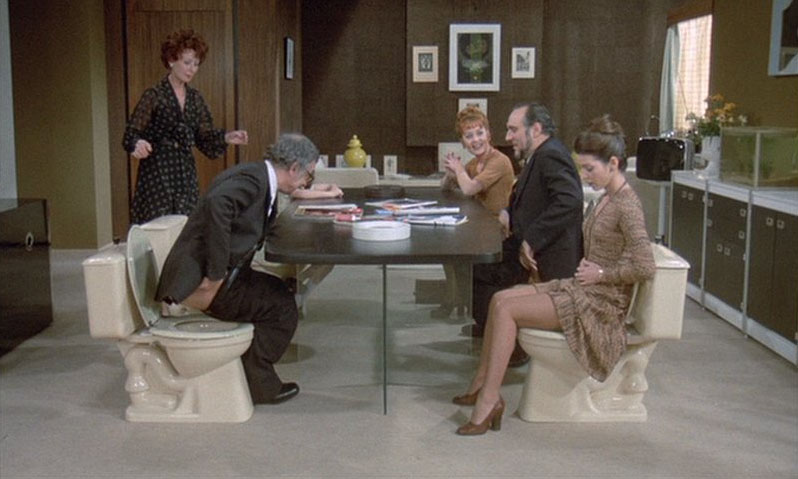
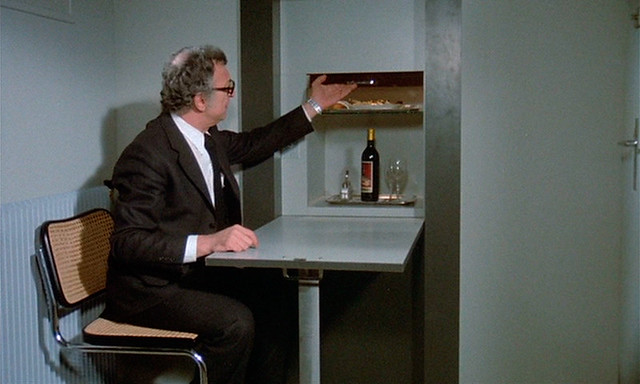
For years, I have been searching for the title of a film that I watched years ago. All that I remember was people were very comfortable hanging out in the toilet but had to bashfully ask others to excuse themselves when going to eat.
No one seemed to recall this film including the friend who watched it with me.
As time goes by, I am starting to wonder whether it really was a film I watched.
Though, voila, today I found out it really existed.
It was Le fantôme de la liberté or The Phantom of Liberty by Luis Buñuel.
Public Toilet
Private dining
Engaging in unspeakablely shameful act called eating in isolation.
But with OCO-2 (psychosis), “there is no validation phase, ... because the measurements have such sensitivity. You’re always validating. Constant validation is an integral part of ensuring the integrity of the dataset (perception).”
Holly Macaroni, this sentence could easily be used to describe the world perceived by a psychotic like me.
“after a year of alligator-wrestling, all of a sudden we can walk it on a leash.”
For me, after years of alligator-wrestling, my alligator has a leach on me. lol
Quotes to my liking in To Kill A Mockingbird and, yes, I only got to this book at this age because I thought I was to see of film of the same title. 8-X
it’s never an insult to be called what somebody thinks is a bad name.
I wanted you to see something about her—I wanted you to see what real courage is, instead of getting the idea that courage is a man with a gun in his hand.
With him, life was routine; without him, life was unbearable. I stayed miserable for two days.
We were surprised one morning to see a cartoon in the Montgomery Advertiser above the caption, “Maycomb’s Finch.” It showed Atticus barefooted and in short pants, chained to a desk: he was diligently writing on a slate while some frivolouslooking girls yelled, “Yoo-hoo!” at him.
“That’s a compliment,” explained Jem. “He spends his time doin‘ things that wouldn’t get done if nobody did ’em.”
puttin‘ on airs to beat Moses.”
I said I would like it very much, which was a lie, but one must lie under certain circumstances and at all times when one can’t do anything about them.
Aunt Alexandra fitted into the world of Maycomb like a hand into a glove, but never into the world of Jem and me.
I understood, pondered a while, and concluded that the only way I could retire with a shred of dignity was to go to the bathroom, where I stayed long enough to make them think I had to go.
“he just has his blind spots along with the rest of us.”
As the county went by us, Jem gave Dill the histories ....
a view indicating a people determined to preserve every physical scrap of the past.
I won’t live to see the law changed, and if you live to see it you’ll be an old man.
“You couldn’t, but they could and did. The older you grow the more of it you’ll see.
Atticus said he didn’t see how anything else could happen, that things had a way of settling down, and after enough time passed people would forget that Tom Robinson’s existence was ever brought to their attention.
I am certain that I watched the film "The Unbearable Lightness of Being" based on the book of the same title when it came out but I seriously doubt that I finished reading the book for one good reason.
My impression of this master piece has been an unbearably miserable one for all these years. Yet, I found myself laughing my head off unterwegs zur finishing this dark comedy, for the first time or not.
It was as if the theme song for the unbearable suddenly quantum leaped from the heavy solemnness of The One You Love
to the lightness of a Diva's Lament.
Both are songs I love except they are definitely on the opposite extremes of the light-heavy continuum.
Is it an artifact of the book-to-film adaptation process or the eyes of the beholder?
Donno.
Following are some quotes from the book though you should read it first in order to get the context info ....
~~~~~~~~~~~~~~~~~~~~~~~~~~~~~~~~~~~~~~~~~~~~~~~~
We can never know what to want, because, living only one life, we can neither compare
it with our previous lives nor perfect it in our lives to come.
There is no means of testing which decision is better, because there is no basis for
comparison. We live everything as it comes, without warning, like an actor going on
cold. And what can life be worth if the first rehearsal for life is life itself? That is why life
is always like a sketch. No, sketch is not quite the word, because a sketch is an outline
of something, the groundwork for a picture, whereas the sketch that is our life is a
sketch for nothing, an outline with no picture.
The tons of steel of the Russian tanks were nothing compared with it. For there is nothing heavier than compassion. Not even one's own pain weighs so heavy as the
pain one feels with someone, for someone, a pain intensified by the imagination and
prolonged by a hundred echoes.
Compassion knew it was being
presumptuous, yet it quietly stood its ground
Unlike Parmenides, Beethoven apparently viewed weight as something positive. Since
the German word schwer means both difficult and heavy, Beethoven's difficult resolution
may also be construed as a heavy or weighty resolution. The weighty resolution is
at one with the voice of Fate ( Es muss sein! ); necessity, weight, and value are three
concepts inextricably bound: only necessity is heavy, and only what is heavy has value ....
This is a conviction born of Beethoven's music, and although we cannot ignore the
possibility (or even probability) that it owes its origins more to Beethoven's
commentators than to Beethoven himself,
We all reject out of hand the idea that the love of our life may be something light or
weightless; we presume our love is what must be, that without it our life would no longer
be the same; we feel that Beethoven himself, gloomy and awe-inspiring, is playing the
Es muss sein! to our own great love.
It would be senseless for the author to try to convince the reader that his characters
once actually lived. They were not born of a mother's womb; they were born of a
stimulating phrase or two or from a basic situation. Tomas was born of the saying
Einma! ist keinmal. Tereza was born of the rumbling of a stomach.
The face is nothing but an instrument panel registering all the
body mechanisms: digestion, sight, hearing, respiration, thought.
Chance and chance alone has a message for us. Everything that occurs out of
necessity, everything expected, repeated day in and day out, is mute. Only chance can
speak to us. We read its message much as gypsies read the images made by coffee
grounds at the bottom of a cup.
Rounding the counter with Tomas's cognac,
she tried to read chance's message: How was it possible that at the very moment she
was taking an order of cognac to a stranger she found attractive, at that very moment
she heard Beethoven? (The power of the synchronicity over the weightless delusions.)
A young woman forced to keep drunks supplied with beer and siblings with clean
underwear—instead of being allowed to pursue something higher —stores up great
reserves of vitality, a vitality never dreamed of by university students yawning over their
books.
You mean you were really jealous? she asked him ten times or more, incredulously, as
though someone had just informed her she had been awarded a Nobel Prize.
Before long, unfortunately, she began to be jealous herself, and Tomas saw her
jealousy not as a Nobel Prize, but as a burden, a burden he would be saddled with until
not long before his death.
True, he would rather have slept by himself, but the marriage bed is still the symbol of the marriage bond, and symbols, as we know, are inviolable.
although they had a clear understanding of the logical meaning of the words they exchanged, they failed to hear the semantic susurrus of the river flowing through them.
If I were to make a record of all Sabina and Franz's conversations, I could compile a long lexicon of their misunderstandings. Let us be content, instead, with a short dictionary.
Being a woman is a fate Sabina did not choose. What we have not chosen we cannot consider either our merit or our failure.
And again [Sabrina] felt a longing to betray: betray her own betrayal.
At the time, she had thought that only in the Communist world could such musical barbarism reign supreme. Abroad, she discovered that the transformation of music into noise was a planetary process by which mankind was entering the historical phase of total ugliness. The total ugliness to come had made itself felt first as omnipresent acoustical ugliness: cars, motorcycles, electric guitars, drills, loudspeakers, sirens. The omnipresence of visual ugliness would soon follow.
was unbounded music, absolute sound, a pleasant and happy all-encompassing, overpowering, window-rattling din to engulf, once and for all, the pain, the futility, the vanity of words. Music was the negation of sentences, music was the anti-word!
a passion for extremism, in art and in politics, is a veiled longing for death.
[For Franz] darkness was the infinite we each carry within us. (Yes, if you're looking for infinity, just close your eyes!)
But for [Sabrina], darkness did not mean infinity; for her, it meant a disagreement with what she saw, the negation of what was seen, the refusal to see.
In the safety of emigration, they all naturally came out in favor of fighting. Sabina said: Then why don't you go back and fight?
When the distinguished emigre heard from the lips of a painter whose pictures he had never seen that he resembled Communist President Novotny, he turned scarlet, then white, then scarlet again, then white once more; he tried to say something, did not succeed, and fell silent.
Sabina said, Unintentional beauty ... 'beauty by mistake.' Before beauty disappears entirely from the earth, it will go on existing for a while by mistake. 'Beauty by mistake'—the final phase in the history of beauty.
The pinnacle of the dramatic possibilities available to my life!
Sheets of paper covered with words pile up in archives sadder than cemeteries, because no one ever visits them, not even on All Souls' Day.
in an avalanche of words,
he resigned himself with a sigh to a sea of words with no weight and no resemblance to life. (So I feel burying in the avalanche of my weightless shit. lol)
Superimposing the painful drama of her country on her person, he found her even more beautiful. The trouble was that Sabina had no love for that drama. The words prison, persecution ... were ugly, without the slightest trace of romance. The only word that evoked in her a sweet, nostalgic memory of her homeland was the word cemetery.
When we want to give expression to a dramatic situation in our lives, we tend to use metaphors of heaviness. We say that something has become a great burden to us. We either bear the burden or fail and go down with it, we struggle with it, win or lose. And Sabina—what had come over her? Nothing. She had left a man because she felt like leaving him .... Her drama was a drama not of heaviness but of lightness. What fell to her lot was not the burden but the unbearable lightness of being.
People use filthy language all day long, but when they turn on the radio and hear a well-known personality, someone they respect, saying fuck in every sentence, they feel somehow let down.
Tomas turned off the radio and said, Every country has its secret police. But a secret police that broadcasts its tapes over the radio—there's something that could happen only in Prague, something absolutely without precedent! (How opportune! Seconds ago I just asked my mom whether I am under governmental watch and taped and etc. And as always I was given a no for an answer.)
They were ready to fight as obstinately against a foreign army as against an umbrella that refused to move out of their way.
that perverse need one has to expose one's ruins, one's ugliness, to parade one's misery, to uncover the stump of one's amputated arm and force the whole world to look at it. (Some definitely might say this about my writing.)
When a private talk over a bottle of wine is broadcast on the radio, what can it mean but that the world is turning into a concentration camp?
[for Tereza, a] concentration camp is a world in which people live crammed together constantly, night and day. Brutality and violence are merely secondary (and not in the least indispensable) characteristics. A concentration camp is the complete obliteration of privacy .... Almost from childhood, she knew that a concentration camp was nothing exceptional or startling but something very basic, a given into which we are born and from which we can escape only with the greatest of efforts. (If a concentration camp is so defined, complete obliteration of privacy, there is no escape from mine since it's weightless, portable, and undetacheable like my shadow.)
Then what was the relationship between Tereza and her body? Had her body the right to call itself Tereza? And if not, then what did the name refer to? Merely something incorporeal, intangible? (Am I the slave of my body and mind and who am I?)
She then went to say good-bye to the ambassador, who had night duty. (It reminds me of this cleaning lady I once knew who was a journalist from her native land.)
She knew that she had become a burden to him: she took things too seriously, turning everything into a tragedy, and failed to grasp the lightness and amusing insignificance of physical love. How she wished she could learn lightness! She yearned for someone to help her out of her anachronistic shell.
Toilets in modern water closets rise up from the floor like white water lilies. The architect does all he can to make the body forget how paltry it is, and to make man ignore what happens to his intestinal wastes after the water from the tank flushes them down the drain. Even though the sewer pipelines reach far into our houses with their tentacles, they are carefully hidden from view, and we are happily ignorant of the invisible Venice of shit underlying our bathrooms, bedrooms, dance halls, and parliaments.
She was sitting there on the toilet, and her sudden desire to void her bowels was in fact a desire to go to the extreme of humiliation, to become only and utterly a body, the body her mother used to say was good for nothing but digesting and excreting. And as she voided her bowels, Tereza was overcome by a feeling of infinite grief and loneliness. Nothing could be more miserable than her naked body perched on the enlarged end of a sewer pipe. (Oh ... shit! Wonder whether it might make her feel better: at least not the ineffable constipation blocking the avalanche of diarrhea.)
Their love was an oddly asymmetrical construction: it was supported by the absolute certainty of her fidelity like a gigantic edifice supported by a single column.
She was thinking about how all things and people seemed to go about in disguise. An old Czech town was covered with Russian names. Czechs taking pictures of the invasion had unconsciously worked for the secret police. The man who sent her to die had worn a mask of Tomas's face over his own. The spy played the part of an engineer, and the engineer tried to play the part of the man from Petrin. The emblem of the book in his flat proved a sham designed to lead her astray. (And messages hiding in plain sight everywhere.)
The river flowed from century to century, and human affairs play themselves out on its banks. Play themselves out to be forgotten the next day, while the river flows on. Reka tece od veku do veku a lidské príbehy se dejí na brehu. Dejí se, aby byly
zítra zapomenuty a reka tekla dál.
Anyone who thinks that the Communist regimes of Central Europe are exclusively the work of criminals is overlooking a basic truth: the criminal regimes were made not by criminals but by enthusiasts convinced they had discovered the only road to paradise. They defended that road so valiantly that they were forced to execute many people. Later it became clear that there was no paradise, that the enthusiasts were therefore murderers.
In the end, the dispute narrowed down to a single question: Did they really not know or were they merely making believe?
But, he said to himself, whether they knew or didn't know is not the main issue; the main issue is whether a man is innocent because he didn't know.
But now that we all know the accusations to have been absurd and the executed to have been innocent, how can that selfsame public prosecutor defend his purity of heart by beating himself on the chest and proclaiming, My conscience is clear! I didn't know! I was a believer! Isn't his I didn't know! I was a believer! at the very root of his irreparable guilt?
You know what's at stake, said the chief surgeon .... He knew, all right. There were two things in the balance: his honor (which consisted in his refusing to retract what he had said) and what he had come to call the meaning of his life (his work in medicine and research).
And suddenly Tomas grasped a strange fact: everyone was smiling at him, everyone wanted him to write the retraction; it would make everyone happy! The people with the first type of reaction would be happy because by inflating cowardice, he would make their actions seem commonplace and thereby give them back their lost honor. The people with the second type of reaction, who had come to consider their honor a special privilege never to be yielded, nurtured a secret love for the cowards, for without them their courage would soon erode into a trivial, monotonous grind admired by no one. (Should I hospitalize myself or not?)
spread through nervous Prague with the uncanny speed of a bush telegraph (Good way to describe the mechanism in which my each and every move is broadcast.)
How defenseless we are in the face of flattery! Tomas was unable to prevent himself from taking seriously what the Ministry official said .... But it was not out of mere vanity. More important was Tomas's lack of experience. When you sit face to face with someone who is pleasant, respectful, and polite, you have a hard time reminding yourself that nothing he says is true, that nothing is sincere. Maintaining nonbelief (constantly, systematically, without the slightest vacillation) requires a tremendous effort and the proper training—in other words, frequent police interrogations. Tomas lacked that training. (And I lacked the training in facing my hallucinations, delusions, etc and I am still an apprentice.)
That's how everyone understood it, said the man from the Ministry, his voice growing sadder and sadder.
If you'd read the complete version, the way I wrote it originally, you wouldn't have read that into it. The published version was slightly cut.
This time Tomas had no trouble responding, because he had told the absolute truth. It's not logical, but that's how it was.
People derived too much pleasure from seeing their fellow man morally humiliated to spoil that pleasure by hearing out an explanation.
Humiliating public statements are associated exclusively with the signatories' rise, not fall. (That was why this two-bit-nothing got herself institutionalized knowing only I had lost my ability to concentrate. There wouldn't be any purpose.)
Tomas suddenly realized that he was not at all sure he had made the proper choice, but he felt bound to it by then by an unspoken vow of fidelity, so he stood fast. And that is how he became a window washer. (That was how I got myself locked up behind the gated doors at the onset.)
Does that mean his life lacked any Es muss sein!, any overriding necessity? In my opinion, it did have one ... it was his profession. He had come to medicine not by coincidence or calculation but by a deep inner desire.
A certain Dembscher owed Beethoven fifty florins, and when the composer, who was chronically short of funds, reminded him of the debt, Dembscher heaved a mournful sigh and said, Muss es sein? ... Es muss sein, es muss sein, ja, ja, ja, ja! (It must be, it must be, yes, yes, yes, yes!), and the fourth voice chimes in with Heraus mit dem Beutel! (Out with the purse!) ..... In Kant's language, even Good morning, suitably pronounced, can take the shape of a metaphysical thesis. German is a language of heavy words. Es muss sein! was no longer a joke; it had become der schwer gefasste Entschluss (the difficult or weighty resolution). (Is this real? 8-O lol)
That, of course, was an external Es muss sein! reserved for him by social convention, whereas the Es muss sein! of his love for medicine was internal. So much the worse for him. Internal imperatives are all the more powerful and therefore all the more of an inducement to revolt.
He had more to say, but suddenly he remembered that the place might be bugged. He had not the slightest ambition to be quoted by historians of centuries to come. He was simply afraid of being quoted by the police.
But isn't it true that an author can write only about himself? Staring impotently across a courtyard, at a loss for what to do; hearing the pertinacious rumbling of one's own stomach during a moment of love; betraying, yet lacking the will to abandon the glamorous path of betrayal; raising one's fist with the crowds in the Grand March; displaying one's wit before hidden microphones—I have known all these situations, I have experienced them myself, yet none of them has given rise to the person my curriculum vitae and I represent.
It was manna from heaven, the perfect start and justification for a new wave of persecution. (Every move, word, and thought it is.)
And again he thought the thought we already know: Human life occurs only once, and the reason we cannot determine which of our decisions are good and which bad is that in a given situation we can make only one decision; we are not granted a second, third, or fourth life in which to compare various decisions.
Einmal ist keinmal. What happens but once might as well not have happened at all. The history of the Czechs will not be repeated, nor will the history of Europe. The history of the Czechs and of Europe is a pair of sketches from the pen of mankind's fateful inexperience. History is as light as individual human life, unbearably light, light as a feather, as dust swirling into the air, as whatever will no longer exist tomorrow. (So is the path I traversed and mystory.)
That man acted as though history were a finished picture rather than a sketch. He acted as though everything he did were to be repeated endlessly, to return eternally, without the slightest doubt about his actions. He was convinced he was right, and for him that was a sign not of narrowmindedness but of virtue. Yes, that man lived in a history different from Tomas's: a history that was not (or did not realize it was) a sketch.
Perhaps he hoped his words would ring so outrageously false that they would wake Hrubin from the dead. But the world was too ugly, and no one decided to rise up out of the grave.
It's perfectly normal for our paths not to cross. There's nothing to get upset about!
And we'd be getting back to nature. Nature is the same as it always was.
I didn't want to tell you, but night after night I've had to breathe in the groin of some mistress of yours.
Was he [Yakov Stalin], who bore on his shoulders a drama of the highest order (as fallen angel and Son of God), to undergo judgment not for something sublime (in the realm of God and the angels) but for shit? Were the very highest of drama and the very lowest so vertiginously close?
If rejection and privilege are one and the same, if there is no difference between the sublime and the paltry, if the Son of God can undergo judgment for shit, then human existence loses its dimensions and becomes unbearably light.
Shit is a more onerous theological problem than is evil. Since God gave man freedom, we can, if need be, accept the idea that He is not responsible for man's crimes. The responsibility for shit, however, rests entirely with Him, the Creator of man.
Hovno je obtížnejší teologický problém než zlo. Buh dal cloveku svobodu a mužeme tedy konec koncu pripustit, že není odpoveden za lidské zlociny. Odpovednost za hovno nese však plne jen ten, kdo cloveka stvoril.
Erigena's argument holds the key to a theological justification (in other words, a theodicy) of shit. As long as man was allowed to remain in Paradise, either (like Valentinus' Jesus) he did not defecate at all, or (as would seem more likely) he did not look upon shit as something repellent. Not until after God expelled man from Paradise did He make him feel disgust.
exactly how Sabina had explained the meaning of her paintings to Tereza: on the surface, an intelligible lie; underneath, the unintelligible truth showing through. (Sounds like conscious/unconscious and feels like delusions.)
she even managed to hide the fact that she was Czech. It was all merely a desperate attempt to escape the kitsch that people wanted to make of her life.
windows shining out into the dying day. (What're the stories within?)
For none among us is superman enough to escape kitsch completely. No matter how we scorn it, kitsch is an integral part of the human condition.
Kitsch has its source in the categorical agreement with being.
It is always nice to dream that we are part of a jubilant throng marching through the centuries, and Franz never quite forgot the dream.
The identity of kitsch comes not from a political strategy but from images, metaphors, and vocabulary.
its pace grows faster and faster, until finally the Grand March is a procession of rushing, galloping people and the platform is shrinking and shrinking until one day it will be reduced to a mere dimension-less dot.
the editor in Prague who organized the petition for the amnesty of political prisoners. He knew perfectly well that his petition would not help the prisoners. His true goal was not to free the prisoners; it was to show that people without fear still exist. That, too, was playacting. But he had no other possibility. His choice was not between playacting and action. His choice was between
playacting and no action at all.
That sudden desire of Franz's reminds us of something; yes, it reminds us of Stalin's son, who ran to electrocute himself on the barbed wire when he could no longer stand to watch the poles of human existence come so close to each other as to touch, when there was no longer any difference between sublime and squalid, angel and fly. God and shit.
... the glory of the Grand March was equal to the comic vanity of its marchers, that the exquisite noise of European history was lost in an infinite silence and that there was no longer any difference between history and silence. He felt like placing his own life on the scales; he wanted to prove that the Grand March weighed more than shit.
But man can prove nothing of the sort. One pan of the scales held shit; on the other, Stalin's son put his entire body. And the scales did not move.
Ale clovek nic takového nedokáže. Na jedné misce vah bylo hovno, na druhou se Stalinuv syn položil celým svým telem a váhy se nepohnuly.
And so one day [Sabrina] composed a will in which she requested that her dead body be cremated and its ashes thrown to the winds. Tereza and Tomas had died under the sign of weight. She wanted to die under the sign of lightness. She would be lighter than air. As Parmenides would put it, the negative would change into the positive.
Napsala proto jednoho dne závet, v niž stanovila, že její mrtvé telo má být spáleno a popel rozprášen. Tereza a Tomáš zemreli ve znamení tíže. Ona chce zemrít ve znamení lehkosti. Bude lehcí než vzduch. Podle Parmenida je to promena negativního v pozitivní.
Only now did he know. He had come to find out once and for all that neither parades nor Sabina but rather the girl with the glasses was his real life, his only real life! He had come to find out that reality was more than a dream, much more than a dream!
Proc sem vubec jel? Ted to ví. Jel sem, aby si konecne uvedomil, že nikoli pruvody; nikoli Sabina, ale jeho brýlatá dívka je jeho skutecný život, jediný skutecný život! Jel sem, aby si uvedomil, že skutecnost je víc než sen, mnohem víc než sen
What remains of the dying population of Cambodia?
One large photograph of an American actress holding an Asian child in her arms.
What remains of Tomas?
An inscription reading HE WANTED THE KINGDOM OF GOD ON EARTH.
What remains of Beethoven?
A frown, an improbable mane, and a somber voice intoning Es muss sein!
What remains of Franz?
An inscription reading A RETURN AFTER LONG WANDERINGS.
And so on and so forth.
People started being removed from their jobs, arrested, put on trial. At last the animals could breathe freely.
The longing for Paradise is man's longing not to be man.
therein lies the whole of man's plight. Human time does not turn in a circle; it runs ahead in a straight line. That is why man cannot be happy: happiness is the longing for repetition.
The light of horror thus lost its harshness, and the world was bathed in a gentle, bluish light that actually beautified it.
a lamp that had never stopped burning in anticipation of her return,
Missions are stupid, Tereza. I have no mission. No one has. And it's a terrific relief to realize you're free, free of all missions.
"…for this may never be made manageable, that things that are not are./ But you from this way of inquiry restrain your understanding,/ and do not let habit born of much experience force you along this way,/ to employ aimless sight and echoing hearing/ and tongue. But judge by reason the strife-filled critique/ I have delivered”
OK ... for a man with a hammer everything looks like a nail--this is psychotic.
“whole and uniform”: “Nor is it divided, since it is all alike;/ and it is not any more there, which would keep it from holding together,/ nor any worse, but it is all replete with What Is./ Therefore it is all continuous: for What Is draws to What Is.”
Some encouraging remarks about the not-so-beaten-es-muss-sein path I have traversed and I am round like a meatball.... lol
Welcome, youth, who come attended by immortal charioteers and mares which bear you on your journey to our dwelling. For it is no evil fate that has set you to travel on this road, far from the beaten paths of men, but right and justice. It is meet that you learn all things — both the unshakable heart of well-rounded truth and the opinions of mortals in which there is not true belief.
Oh... Mr. Parmesan Cheese (Easier to remember) is grand-father-in even though not quite enough is left about what he actually said.
Parmenides' considerable influence on the thinking of Plato is undeniable, and in this respect Parmenides has influenced the whole history ofWestern philosophy, and is often seen as its grandfather.
What is so commonplace today was once-upon-a-time prior ignorance. Wow!
A shadow of Parmenides' ideas can be seen in the physical concept of Block time, which considers existence to consist of past, present, and future, and the flow of time to be illusory. In his critique of this idea, Karl Popper called Einstein "Parmenides".[25] However, Popper did write:
So what was really new in Parmenides was his axiomatic-deductive method, which Leucippus and Democritus turned into a hypothetical-deductive method, and thus made part of scientific methodology.[26]
Finally finished reading Main Street and I think it might be a good time to do some reflection on what I gathered through reading.
Everyone has a life story in which someone else's garden is always greener and no suffering could be grander than one's own.
Back to quotes I like from Main Street by Sinclair Lewis:
settled into submission to poverty.
among the shadows of dead thoughts and haunting repressions.
the unprotected houses would crouch together in terror of storms galloping out of that wild waste.
An impressive barricade of green and gold wheels, of shafts and sulky seats, belonging to machinery of which Carol knew nothing— potato-planters,
Miss Bea was a stalwart, corn-colored, laughing young woman, and she was bored by farm-work. She desired the excitements of city-life, and the way to enjoy city-life was, she had decided, to "go get a yob as hired girl in Gopher Prairie." (Good contrast!)
shining with welcome.
let her tired spirit be absorbed in the Nirvana of the incomparable sky.
the decency of clean bareness.
One trouble with books is that they're not so thoroughly safeguarded by intelligent censors as the movies are,
My religion is so foggy.
overwhelming belief in the brains and hearts of our nation, our state, our town.
this high-art stuff that doesn't encourage us day-laborers to plod on."
Let's make Gopher Prairie rock to its foundations: let's have afternoon tea instead of afternoon coffee. (What's the tea and coffee thing? Don't get it 8-O)
She wheezed in, sighed, gave Carol a pulpy hand, sighed, glanced sharply at the revelation of ankles as Carol crossed her legs, sighed, inspected the new blue chairs, smiled with a coy sighing sound, and gave voice ...
the party was again elevated to the decorum of a prayer-meeting.
Raymond hasn't an unusually good voice, but don't you think he puts such a lot of feeling into it? (Sounds almost like my writing. lol)
poisoned with doubt,
herself— overstimulated by the drug of thought, and offensively on the defensive.
an intellectual squalor; a swamp of prejudices and fears.
a seed to sprout and some day with thickening roots to crack their wall of mediocrity.
(This book is very Woody Allen style though Lewis came first.)
there can never be genuine beauty without the message from the heart.
Carol's hero-worship dwindled to polite nodding, and the nodding dwindled to a desire to escape, and she went home with a headache.
God has never done much but creep around and try to catch us disobeying it.
Then I found that the Village Virus had me, absolute .... That's all of the biography of a living dead man, except the diverting last chapter, the lies about my having been 'a tower of strength and legal wisdom' which some day a preacher will spin over my lean dry body."
And the penalty we tribal rulers pay is that our subjects watch us every minute. We can't get wholesomely drunk and relax. We have to be so correct about sex morals, and inconspicuous clothes, and doing our commercial trickery only in the traditional ways, that none of us can live up to it, and we become horribly hypocritical.
Oh, my dear, I haven't talked to anybody about myself and all our selves for years."
You are within your legal rights in refusing to be subjected to this summing-up. I'm a tedious old fool analyzing the obvious, while you're the spirit of rebellion.
I'm trying to develop my own large capacity for dullness and contentment.
in great dignity and self-dramatization, she returned to bed.
you always talk so much about getting all you can out of life, and not letting the years slip by, and here you deliberately go and deprive yourself of a lot of real good home pleasure by not enjoying people unless ....
You'll find these characters in all these small towns, and a pile of savvy in every single one of them, if you just dig for it."
Night witchery and morning disillusion were alike forgotten in the march of realities and days.
She was like the revolutionist at fifty: not afraid of death, but bored by the probability of bad steaks and bad breaths and sitting up all night on windy barricades.
She was snatched back from a dream of far countries, and found herself on Main Street.
The words and the light blurred into one vast indefinite happiness,
The night expanded, she was conscious of the universe, and all mysteries stooped down to her. (This is a good way of describing that winter night when I found in myself with the power to connect with stars etc--the universe and beyond.)
they said the same things in the same hearty monotonous voices.
the only way to be artistic is to present Shakespeare. As no one listened to her she sat back and looked like Lady Macbeth.
They had borrowed Carol's manuals of play-production and had become extremely stagey in vocabulary.
frightened into paralysis.
for three years which passed like one curt paragraph,
Her condescension was ruined and her humility wholesomely increased
In the plodding course of her life there was nothing changed, and nothing new.
THE greatest mystery about a human being is not his reaction to sex or praise, but the manner in which he contrives to put in twenty-four hours a day. It is this which puzzles the long-shoreman about the clerk, the Londoner about the bushman.
It has not yet been recorded that any human being has gained a very large or permanent contentment from meditation upon the fact that he is better off than others. (Lord, this is great! lol)
she felt herself being ironed into glossy mediocrity, and she rebelled, in fear.
The cloud of serene ignorance submerges them in unhappiness and futility.
Not till he had climbed to his office and found another sign on the door, another Dr. Kennicott inside, would he understand that something curious had presumably happened.
"... How can you expect to do anything with it if you haven't any sympathy?" "But I have! And affection. Or else I wouldn't fume so.
Passengers looking from trains saw her as a village woman of fading prettiness, incorruptible virtue, and no abnormalities;
raged mutely against the indifferent gods:
Do they think they can make me believe that a display of potatoes at Howland & Gould's is enough beauty and strangeness?"
"The young do the work while these old ones sit around and interrupt us and gag with hate because they're too feeble to do anything but hate,"
making an earnest business of sleeping.
He's a servant of reality."
"You don't have to stay. I do! So I want to change it.
to tear at the shroud of intimacy, to perceive the strangeness of the most familiar.
She shut the door on her thoughts. That was sacred ground.
he was shocked by Carol's lack of faith, and wasn't quite sure what was the nature of the faith that she lacked. (lol)
he had the grace of a cat. (Nice!)
I wonder how much of the cement is made out of the tombstones of John Keatses? (Never read Keats other than roses are red. But this sounds good.)
the town's principle of perfect democracy was not meant to be applied indiscriminately. (Some variation to all animals are equal.)
flamed like a recent convert to any faith.
myths that broad plains necessarily make broad minds, and high mountains make high purpose.
be bullied and BULLIED by the faith that the future is already here in the present, and that all of us must stay and worship wheat-stacks and insist that this is 'God's Country'— and never, of course, do anything original or gay-colored that would help to make that future! Anyway, you don't belong here.
"Though I despise these people who interfere. He must be independent."
unheroic heroine in a drama insanely undramatic. (Why can't I build sentences like this?!)
But she knew that she still had no plan in life, save always to go along the same streets, past the same people, to the same shops.
the house reeked with a colorless stillness.
The chart which plots Carol's progress is not easy to read. The lines are broken and uncertain of direction; often instead of rising they sink in wavering scrawls; and the colors are watery blue and pink and the dim gray of rubbed pencil marks. A few lines are traceable.
She knew that there was nothing heroic or obviously dramatic in it, no magic of rare hours, nor valiant challenge, but it seemed to her that she was of some significance because she was commonplaceness, the ordinary life of the age, made articulate and protesting.
ask why it is, and who first laid down the law that it had to be that way. If enough of us do this impolitely enough, then we'll become civilized in merely twenty thousand years or so, instead of having to wait the two hundred thousand years
I may not have fought the good fight, but I have kept the faith."
Quotes from The Age of Innocence by Edith Wharton. I had no idea until somewhere in the reading process that the author was actually female. lol
It was a winter evening of transparent clearness, with an innocent young moon above the house-tops (p. 86).
the Family Physician annoyed with a patient whose symptoms refuse to be classified. (p. 83).
Does no one want to know the truth here, Mr. Archer? The real loneliness is living among all these kind people who only ask one to pretend!" (p. 70).
from farther wounding herself in her mad plunges against fate. (p. 86).
accepted them as part of the structure of his universe. He knew that there were societies where painters and poets and novelists and men of science, and even great actors, were as sought after as Dukes; (p. 92).
wondering if it were lightness or dissimulation that enabled her to touch so easily on the past at the very moment when she was risking her reputation in order to break with it. (p. 95).
plunged out into the winter night bursting with the belated eloquence of the inarticulate. (p. 102). (Wow ... beautiful!)
over many of them the green mould of the perfunctory was already perceptibly spreading. (p. 113).
what would become of this narrow margin of life in which his real experiences were lived? (p. 113).
whose horizon was bounded by the Battery and the Central Park. How should any one coming from a wider world not feel the difference and be attracted by it? (p. 124).
the thought that a barrier of words should drop between them again. (p. 152).
too intelligent to be the slave of such absurd superstitions. (p. 153).
"It's their armour," he thought, "their defence against the unknown, and their defiance of it." (p. 178).
this eager impecunious young man who had fared so richly in his poverty. (p. 180).
What if "niceness" carried to that supreme degree were only a negation, the curtain dropped before an emptiness? (p. 191).
it was the same world after all, though he had such a queer sense of having slipped through the meshes of time and space. (p. 205).
so chained to their separate destinies that they might as well have been half the world apart. (p. 219).
she said, as if it were something visible and measurable, like a crack in a house. (p. 232)
sank back into the thought (p. 274)
There was nothing unknown or unfamiliar in the path he was presumably to tread (p. 278).
it made the righteous reprobation of New York seem like a passing by on the other side. (p. 280).
mouldered in unvisited loneliness. (p. 281).
Its glass shelves were crowded with small broken objects— hardly recognisable domestic utensils, ornaments and personal trifles— made of glass, of clay, of discoloured bronze and other time-blurred substances ... after a while nothing matters ... any more than these little things, that used to be necessary and important to forgotten people, and now have to be guessed at under a magnifying glass and labelled: 'Use unknown.'" (p. 282).
suffer the stupid law of change. (p. 282)
walked listlessly through the room like a ghost stalking through a necropolis. (p. 284)
Conformity to the discipline of a small society had become almost his second nature. (p. 295)
looking over at her as if the slight distance between them were an unbridgeable abyss. (p. 297)
in a state of odd imponderability (p. 307)
He guessed himself to have been, for months, the centre of countless silently observing eyes and patiently listening ears; he understood that, by means as yet unknown to him, the separation between himself and the partner of his guilt had been achieved, and that now the whole tribe had rallied about his wife on the tacit assumption that nobody knew anything, or had ever imagined anything, and that the occasion of the entertainment was simply May Archer's natural desire to take an affectionate leave of her friend and cousin. (p. 308) (This and some following verses are perfectly psychotic!)
It was the old New York way of taking life "without effusion of blood": the way of people who dreaded scandal more than disease, who placed decency above courage, and who considered that nothing was more ill-bred than "scenes," except the behaviour of those who gave rise to them. (p. 308)
The talk swept past Archer like some senseless river running and running because it did not know enough to stop. (p. 311)
so the evening swept on, running and running like a senseless river that did not know how to stop. (p. 311)
Now, as he reviewed his past, he saw into what a deep rut he had sunk. (p. 323)
There are moments when a man's imagination, so easily subdued to what it lives in, suddenly rises above its daily level, and surveys the long windings of destiny. (p. 323)
in the odour of prosperity (p. 324)
"The difference is that these young people take it for granted that they're going to get whatever they want, and that we almost always took it for granted that we shouldn't. (pp. 324-325)
it had never been possible to inculcate in him even the rudiments of reserve. (pp. 326-327)
You just sat and watched each other, and guessed at what was going on underneath. A deaf-and-dumb asylum (p. 327)
He had to deal all at once with the packed regrets and stifled memories of an inarticulate lifetime. (p. 327)
only a pathetic instance of vain frustration, of wasted forces. (p. 328)
while the stream of life rolled by.... (p. 328)
The boy was not insensitive, he knew; but he had the facility and self-confidence that came of looking at fate not as a master but as an equal. (p. 329)
The day was fading into a soft sun-shot haze, pricked here and there by a yellow electric light (p. 330)
"It's more real to me here than if I went up," (p. 332) (Too much reality is not what people want. lol)
Just finished reading "The Humans: A novel", a book about an unprepared alien spy on earth, and found some interesting quotes to share with the Humans or otherwise.
She was suffering from grief. A grief for not just the loss of her husband but also the loss of familiar reality. (P. 250)
You had to stay consistent to life's delusions. All you had was your perspective, so objective truth was meaningless. You had to choose a dream and stick with it. (P. 251)
Don't try to be cool. The whole universe is cool. It's the warm bits that matter. (p. 258)
Make sure, as often as possible, you are doing something you'd be happy to die doing. (P. 260)
When you watch the news and see members of your species in turmoil, do not think there is nothing you can do. But know it is not done by watching news. (p. 260)
At the subatomic level, everything is complex. But you do not live at the subatomic level. You have the right to simplify. (p. 261)
And now I'm here with nothing, but I am myself with nothing. An honest bloody nothing. (P. 271)
'Tis the sign from upstairs for the day. So it concludes In Plain Sight--Voir
(Now I have my fun--insane in my own eyes. lol Back to work work. :-|)
P.S., The core of psychotic thinking-everything is coded and signs are everywhere. e.g., Ratprincess Bored vs. Jason Borne-the movie I just watched. (Come to think about it. Gotta check to see whether it's done in my writing.)
Was reading up Information Mechanics, a theory proposed by my friend Fred and find the following quotes in one of the article particularly interesting. Think I would share with you.
A theory is unable to explain its own assumptions. A theory which tries to do so is called a tautology.
Space, time, mass, energy ... are put into CM (classical mechanics) and QM (quantum mechanics) as assumptions. For this reason, it is not possible for CM and/or QM to explain any of them; a fundamentally different tool, which does not use those assumptions is necessary.
KANTOR, F. (1986-12-01). Information Mechanics Perspective on Some Assumptions in Classical Mechanics and Quantum Mechanics about Measurement. Annals of the New York Academy of Sciences, 480(1 new technique), 581-584.doi:10.1111/j.1749-6632.1986.tb12467.x
Please see a brief description of Fred's theory below.
Decided to pull out this love letter again today and found the object of love could be the books or the readers I try to reach with loving intentions.
Is it pure dumbness, insanity, or faith? Donno.
The only thing I am certain is "I would not be beshamed to confront myself and will not regret in the future having nothing done" because I am doing and have done the best I can despite of constraints. As for the outcome, "I still do not know where it will go" and beyond my control.
Ratology Reloaded: The answer: Rereading Da Eternal Love ... The question I have for myself is that... Was it pure dumbness or was it faith? Is it better to fall freely...
Some useless mumble jumble when the fountain is running dry .... Muse, muse, where art thou?
Da Eternal Love
Waking up in the morning, I saw the weather had changed. I was wondering how cold it would be this year. Would it be colder or milder? I cannot choose nor do I have the power to decide the weather condition. The only thing I could do is to decide my own attitude towards the conditions. I am no pan-determinist but I apprehend that the truth that human being is not omnipotent.
Likewise, falling in love was just a state of mind. It made me anxious and somehow spoiled my life. Should I have stayed cool and calm, no extreme disturbance would have occurred and so much more work could have been done. Flirtation does no harm inasmuch the heart does not become involved. However, I betrayed my best interest and fell into a chaotic phase.
If I wanted to protect myself from being hurt by the same old scenario, I should have held back my affection, blockaded my emotions, and kept you away from my sight. Yet, I refrained from withdrawing. I refused to regress to the infantile stage of "out-of-sight-out-of-mind". I saw that, in the distant future, our fates would converge: not referring to our together-here-after-happy-life, but rather the inescapable end of our life journey. I could not bear seeing myself regretting when it is too late, the words I could have said and the things I could have done.
Some said that my thoughts are morbid and a smile is the response. For I always know that, if life is mortal and nothing lasts forever (not even diamond), I had better strive to live my life for significance. This belief gives me the strength to hold on. Out of the question, you or anyone else could not comprehend what could have and still sustain my faith in love, because neither could I. A friend of mine once questioned me, "How is it possible for you to be in love this way?" There is no easy answer. The only thing I can say, is......
Value does not push men to do a deed; it can only pull one to towards an action.
I have to be the one in charge of my fate, at least partially. Since the day that I realized the insufficiency of my being, I made up my mind to be what I want to be with all my might, disregarding the inevitable agony and distress. I want to be with you and it will always be the statement of my life. It reveals my cathexis in you, regardless my realization in the ultimate destiny, not death but aloneness. I know for sure that, before death, we can never avoid being alone. We will be sitting under the sunset, precipitating our demise. We might be surrounded by people, but still deemed to be alone, just like those in a nursing home.
You always asked me why I volunteered in places like the hospital where bereavement and suffering takes place. The scene might not be pleasurable yet insightful. There, I saw how ephemeral life could be and I learned how precious our infinitesimal life is. Such experiences might have reinforced my fixation in you. Thus, I promised myself that I would always cherish the time with you.
You know something? I am the one who is responsible for the inconsolable situation in which I am trapped. I did not withhold my feelings and just let it flow. I have to take my share of responsibility for the free-running emotion of mine. As a human being, I have the freedom to choose. The price I paid for this freedom is the obligation to commit myself to this engagement. Therefore, when I said to you that "I will be waiting for you", it was also a commitment to myself. I did not and still do not regret it, and, I surely will not. As long as I give myself this try, whatever the cost may be, I am making effort to authenticate my life. I would not be beshamed to confront myself and will not regret in the future having nothing done.
However, in bearing the responsibility, I am also making effort to prevent myself from being vulnerable. When I am responsible, I have the control to make the next movement rather than waiting for the stars to fall. It helps me be stronger. Thus, my days would not be like hell.
I am not like a tyrant. You have your own existence and you make your own choice. I could not force you to accept my affections as they are. I had set no ultimate goal for my trials since no one has power over his own destiny. I am no pan-determinist; however, I believe in fate. I had managed, and, will continue to push my fate some more, although I still do not know where it will go.
Since I am still trying to get my books out and there is a feeling that my whole body is decaying in the speed of light, I start to all things to keep the writing process and my body moving.
Then, the notion of chakra came upon me and I got matching stones placed on my 7 chakras in the night. (Yes, I am crazy but whatever works to get the writing done.)
This morning, when I tried to go back to sleep after a toilet break, I laid the stones in their usual locations, placed my right hand up on my pillow, and tried to sleep.
Suddenly, the clear crystal standing between my eye brows jumped into my hand. Whether I was dreaming about it or not, I went on trying to get back to sleep.
UV enabled movement? Lord, I was in bed trying to sleep.
Strange things happen to me all the times but this one crystal jump got my attention---my bed is far from the windows, and should the UV hypothesis holds, doesn't it mean I have to wear sunscreen even when sleeping?
Whit
-
Whit sounds like wit and according to dictionary.com, it means
a particle; bit; jot (used especially in negative phrases).
I have changed not a whit. I do...
A dream: Backpacking
-
On my way back from NYC to Taipei in April, I managed to get myself an
extended layover (over 2 weeks) in Japan, landing at and exiting from the
Narita Air...
Ratprincess in Technology not lost?
-
Given my sick-in-the-headness, sometimes it's hard to trust my LTM. Did
Ratprincess in Technology really exist or was it my false memory?
As I was marv...
Traces of the past
-
A link I found that has been live online from the Down with Meds age.
Apparently, the past has always been there whether I knew it or not.




 Posts
Posts

