Wednesday, February 4, 2015

Space Shuttle Columbia

I remember that day when the accident happened.


I was on the eighth floor of St. Lucke's, looking out of the window at the St. John, telepathically communicating with the astronauts while wishing God for a miracle to let all to be safe and sound.


NASA reports new details of Columbia deaths

Sunday, February 1, 2015

Death of Death as in Death of a Black Hole

Black holes have always been something so very mysterious to me.

In my much younger years, I learned that after a star much much bigger than our sun goes bye bye, it could turn into a black hole--with things dragging into it failing to escape as if in quicksand, and possibly creating an entrance to another universe.

Then I learned that not only do black holes swallow up stars and give birth to baby universes, they could also help to deliver the birth of baby stars--through the jet streams they spew out after biting more than they could chew.

It had never occurred to me until today that, "Since nothing last forever, could Black Holes, sort of like death itself, die?

That's an interesting new question to me though an old question, apparently, to the others.

In short, yes, theoretically, death itself could face its own death as black holes will die eventually save I won't live long enough to see it and, possibly, even this universe we reside in isn't old enough to behold its occurrence.

Read Quote of Frank Heile's answer to What would the "death" of a Black Hole look like? on Quora

Evaporation, what an interesting kind of terminal death--reminding me how everything died "cleanly" after their death by evaporating into the ether through my body during my second Apocalypse. :-O

Sunday, January 18, 2015

Woolfy Style and expectation again

After finishing A room of one's own with the slot game of "the big bad wolf and three piglets" spinning on its own on the side, I found myself in a fog.


Ok, I did find traces of Mrs. Dalloway but "This is the Woolfy style?"

The fog I found myself in was a result of cognitive dissonance. Something expected was missing.

Based on the impression I got from bibliographical info online or the movie, The Hour, there had to be a hint of depression (not quite sure whether it's the right word) in the writing of this legendary lady who went with the river of no return--like what I sensed in Wallace's "A supposedly fun thing I will never do again," which, by the way, was considered as extremely funny and humorous by quite a lot of people.


Since I don't know squat about literature and writing, I have no business to meddle with what might contribute to what I sense in people's writing, or the content.

One thing I know is that Woolf must have had the work done when depression gave her a break, whether she was in the manic phase or not. If it's true, I have to really thank her for managing to bring herself out of depression when not required to be in it. It's because it somehow pains me greatly to read things that are supposed to be on the sunny side while something in the writing tells me, "The author is sort of like ... very depressed?"--whether the authors themselves know it or not, and whether it's my disordered thinking or not.

I was actually pretty afraid of Virginia Woolf--more precisely, reading her work--A room of one's own. It's a good thing that the estimated value of expectation is far off from the true value this round, when I learn that the "my feel" kind of thing is considered by me part of the stuff called a style (whether it belongs to other people's style or not, and whether it would remain so for me or not).


(P.S., Though I said I don't have the audacity to comment on the content, Woolf's emphasis on the progression of the collective does remind me of my call for the mental nation to strive on, helping ourselves and helping others to help ourselves, for the benefit of the future generation of we mentals--in the book I completed that was far too long and thus not published.)

Saturday, January 17, 2015

Curious George et al

I think that I knew Adam Bede was written by George Eliot when listening to the audio book.

Apparently, in Du côté de chez Swann, the rare volume of Proust's work that I managed to plow through, writing of George Sand were mentioned.

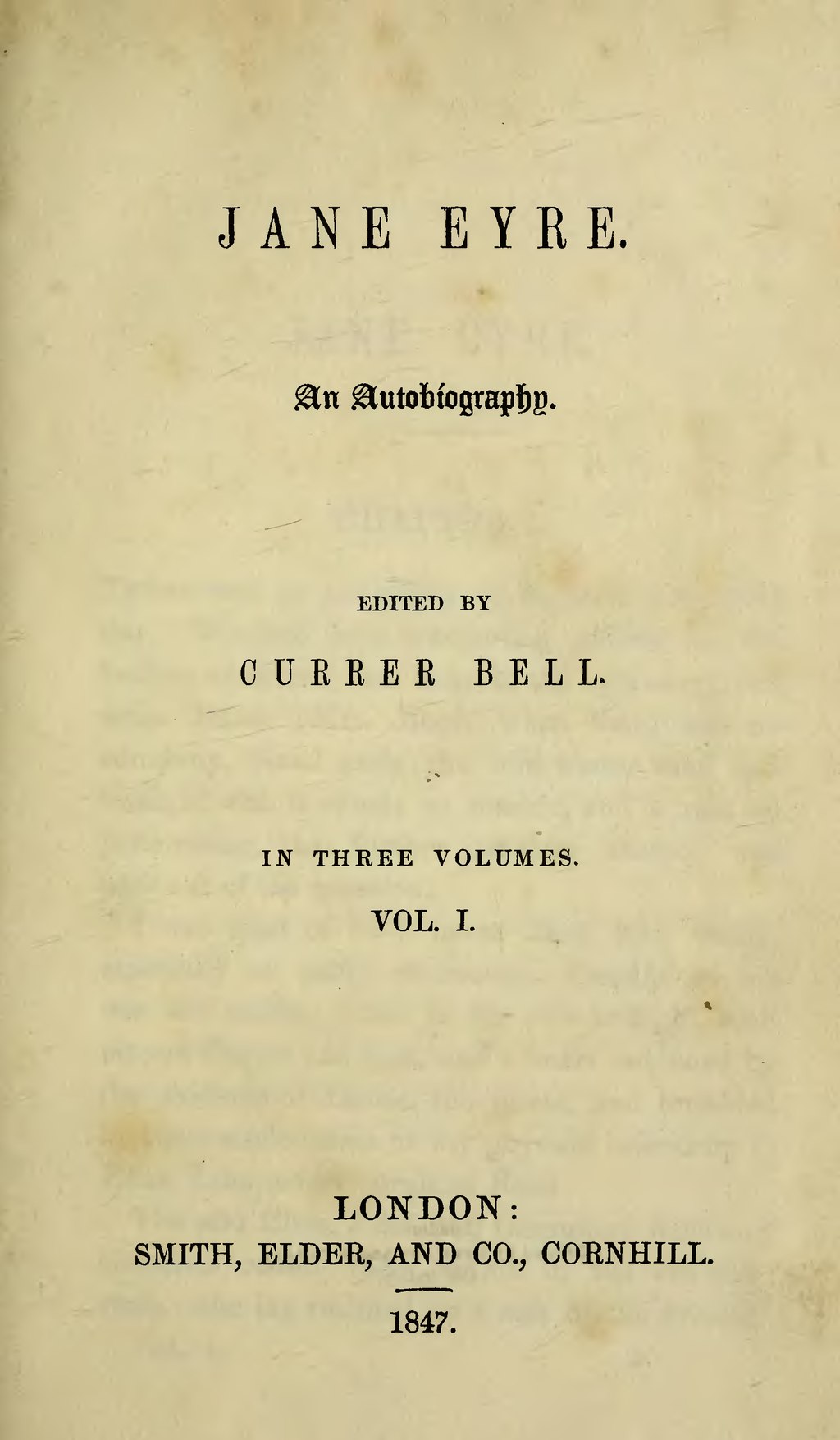
When I read the Chinese version of Jane Eyre, it never occurred to me the book was written by Currur Bell.

I just encountered these names when going through the rationale of Woolf's claim that in order for a woman to write fictions, she needs to have money and a room.

No, I didn't come to this book because I want to write fictions. I am already beyond sick and tired of writing with my limited English proficiency at this point. I arrived at this book because I have no inkling of the Woolfy style.

Then, I came across this sentence as I was trying to get a sense of this style thing ...

"Currer Bell, George Eliot, George Sand, all the victims of inner strife as their writings prove, sought ineffectively to veil themselves by using the name of a man."

This illiterate thought, "Eh, the name George Eliot sounds familiar."

The sense of familiarity led me to reread the sentence again, which got me confused, "You mean these men were women?" (And, yes, there really can be someone ignorant like me.)

So I went googling around, "Wow, it's true. The authors were female except they used a male pen name. They could have saved the whole trouble if their parents had named them with my name since it's a male name."

Then it struck me--the power of expectation in the process of mindless interpretation.

Midway through the book, I know where Virginia Woolf was going even though I have been reading more for her style than for content. Yet, despite the context and the fact that she explicitly stated that A, B, and C used "the name of a man," upon the presence of A, B, and C, a part of my head already established the expectation that these male authors were mentioned for certain argumentative purpose. As a result, my head almost stopped processing upon the presence of that expectation.

Since the purpose of my reading is to get a sense of the Woolfy style, it's nothing traumatic except, "Shit! How much of what I have learned in life so far is a result of the George et al phenomena?" :-X

Anyways, not quite sure whether this book is representative of the Woolfy style since it seems to be different from the trip Mrs. Dalloway took to get the flowers--as long as it's not like searching through Torrents of Spring for Hemingway's style. lol

(Thought I might post something since it's been a while since my last blurb.)


Thursday, December 11, 2014

My favorite sentence in Catch 22

I have been told that it's no good to write long sentences. Given my command or lack of command in the English language, it's for my benefit to shy away from long sentences for fear of grammatical and syntactical errors.

I have to say though that, despite the ineffable agony it took for me to plow through the book while cursing Mr. Heller away for using too many words, I was immensely amused by the sentence in italics even though it was three o'clock in the morning during a time when I was still climbing out of the bottom of my damn depression.

"... Pandemonium broke loose. It took almost a full minute for Appleby to disentangle himself from Orr's flailing arms and legs and grope his way to his feet, with Orr held off the ground before him by the shirt front in one hand and his other arm drawn back in a fist to smite him dead, and at that moment Yossarian stepped forward and took Orr away from him. It was a night of surprises for Appleby, who was as large as Yossarian and as strong and who swung at Yossarian as hard as he could with a punch that flooded Chief White Halfoat with such joyous excitement that he turned and busted Colonel Moodus in the nose with a punch that filled General Dreedle with such mellow gratification that he had Colonel Cathcart throw the chaplain out of the officers' club and ordered Chief White Halfoat moved into Doc Daneeka's tent, where he could be under a doctor's care twenty-four hours a day and be kept in good enough physical condition to bust Colonel Moodus in the nose again whenever General Dreedle wanted him to."

About 30 something supposedly the most humorous and funniest books later, it's time for me to reflect on what good these books are for me.

One thing for sure, I don't have what it takes to construct a sentence, albeit long, hilarious as such (and, of course, many other more lol)! 

Sunday, November 2, 2014

My Two Cents: Blogging about Psychosis?

I had thought that, after last night's posting, I am to not blog for at least a few more weeks if not months. Then, when trying to find information about whether it's a good thing for patients to have insight about their mental health problem and admit it, I came across this article on BBC (http://www.bbc.com/news/health-29861510) today which made me feel compelled to offer my two cents.

Apparently, the experts are now asking people to blog about their psychosis: something I have done for over a decade and was to promote, sort of, in my book.  Except, having blogging myself into the psychiatric ward, I am a living case of how blogging publicly about one's own psychotic symptoms could actually do more harm than good.

Believe me, when you are so psychotic that you believe you are telepathic or your thoughts are broadcast, it's very unlikely that your mental condition will benefit from the reality that you really are broadcasting yours symptoms to the public like Anderson Cooper live from Gaza's front line with a bomb blowing up right behind.

Private blogs which could only be accessed by the authorized people, would be a good way of doing it, especially when there are professionals closely monitoring the writing. Unfortunately, based on my experiences with my private blog "Ratology at Heal," which is only accessible to mes, myselves and Is, even private blogs are not fail-safe because my paranoid self has never stopped for a day believing that my private blogs are read by unauthorized people, meaning, people other than me.

Regardless, my best wishes to this project and the well-being of the participating patients.  At the same time, it's my most sincere hope that the professionals really could make the best use of the captured utterances to maximize the therapeutic advantages of blogging--something I have used my life to test for the past decade. I believe that it will help although we patients might need others to help us catch our own disordered.

Most importantly, we all should keep this in mind, as per the hallucination at my onset, "Do no harm."

Bon Chance!


Saturday, November 1, 2014

Them Apocalypses

Throughout the years, I mumble-jumbled about my apocalypses and how purgatorio, paradiso, and inferno all went adios, resurrected, went adios, etc.

The reality is that I have never really read the bible and I have no inkling what the Apocalypse was supposed to be like according to the bible.

I might have read a verse or two when I went with this friend to the Unfinished on the Bunny Day one year. If I recall correctly, they were talking about the story of how Moses led the Israelites to escape through the opening of the Red Sea, and how the the closing of the Red Sea drowned all Egyptians soldiers coming after them. I also know about famous verses like "In the beginning was the word" and "In the beginning God created heaven and earth ...." 

Shamefully, this is about as much text I have read in the Bible. My close-to-nonexisting exposure to the sacred text absolutely appalled one hard-core atheist friend (and I thought that he was about to un-friend me for it) because it is such a literary classic so beautifully composed.

Anyways, so, I spent the last 2-3 days finishing up reading Good Omens, where creatures were running around trying either to ensure that the Apocalypse takes place or to stop it from happening.

Then, it occurred to me how blessed I only had to live through and to revert them unannounced apocalypses one after another without the foresight that, "Odds fish! How on earth am I to prevent it from happening?"

One thing I figured from this book is that the purgatorio is definitely going to be gone with the wind upon the apocalypse. This leads me to wonder: since my apocalypses seemed to have overshot the apocalyptic criteria, perhaps my apocalypses are not the same as The Apocalypse and I should name them something else ... like ... Total Ec-lypses? 8-O


Thursday, October 16, 2014

Heavy, Writing

The first draft of one chapter of this new book was written in the dire of MY major depression. After reading it, this copyeditor of mine had me told, "It's too heavy. You need to make it lighter and funnier."

Then, after months of pulling my hair out trying to make my own words lighter and more humorous, I came across the following anecdote about the consequences of heavy writing, which made me laugh my head off.

A Heavy Play.—When Sir Charles Sedley's comedy of "Bellamira" was performed, the roof of the theatre fell down, by which, however, few people were hurt except the author. This occasioned Sir Fleetwood Shepherd to say, "There was so much fire in his play, that it blew up the poet, house and all." "No," replied the good-natured author, "the play was so heavy, that it broke down the house, and buried the poor poet in his own rubbish."

Various (2012-05-17). The Book of Three Hundred Anecdotes Historical, Literary, and Humorous - A New Selection (p. 40). . Kindle Edition.

Sunday, October 5, 2014

Catch-22

I decided to pick up some humorous classics since my training in academic writing didn't cover the humor department and a classic is something everyone wished to have read. Now I have plowed through Catch 22 like how Orr rowed himself on that raft to Sweden, I have to agree that Catch 22 is one fun book to read with the embedded humor characterized by disordered-ness. I could do away, though, with the depressing part towards the end though when too many people were dropping and the tone turned serious.

Done with the reading, I just got on the raft of having to figure out how my propelling through this book could assist me in rowing through the humorization process of my writing.

Before I get to Sweden, let me share this direct quote with you. So this is where Catch-22 came from:

"'Sure there's a catch,' Doc Daneeka replied. 'Catch-22. Anyone who wants to get out of combat duty isn't really crazy.'
There was only one catch and that was Catch-22, which specified that a concern for one's own safety in the face of dangers that were real and immediate was the process of a rational mind. Orr was crazy and could be grounded. All he had to do was ask; and as soon as he did, he would no longer be crazy and would have to fly more missions. Orr would be crazy to fly more missions and sane if he didn't, but if he was sane he had to fly them. If he flew them he was crazy and didn't have to; but if he didn't want to he was sane and had to. Yossarian was moved very deeply by the absolute simplicity of this clause of Catch-22 and let out a respectful whistle."

BTW, the medal scene from the film.

Friday, October 3, 2014

Unmerited suffering

I have been stuck in a state of not-a-whit-of-wit while trying to humorize my amateur version of "Les Mis" accidentally created as depression slyly sneaked out on me throughout the months described in my last post.

As a psychotic depressive (in major depression) with the biggest fear as the complete opposite of Yossarian's in Catch 22 and the premonition of the pending death enriched by the auditory hallucination of "Death be upon you" following me like my half shadow, it's an immensely interesting pursuit to try to be humorous and funny in writing on matters that apparently pained me so much that I actually went back to the psychiatric ward (e.g., the denial of green card, financial issues, facing the abnormal pain and mobility issues that would not go away).  Worst of all, because I was too depressed to be humorous to begin with, trying to be humorous to no avail during the revision process and consequentially making no progress depressed me even more, especially when effects of anti-depressant was slacking away, taking its time to work.

This quota of my unmerited suffering leads me to conclude that because it's been a long long time since I last dealt with major major major major kind of depression that last so long, I have become rusted in being depressed (and it's a good thing that my books focus on psychosis rather than on depression). Also, I suspect that the attempt to be funny and humorous is actually a depressant when in major depression even though they say that humor etc helps. I would actually suggest against intentional attempts to be humorous and funny unless your psychotic self also push you to work through a book that requires humor to lighten things up. Nonetheless, unintentional humor seems kosher still.

Just a state report summarizing what I have been down to and a followup for my last post.


A quote to share with you (where I got the title from):
"to reconcile belief in an omnipresent, omni-benevolent God with the fact of unmerited suffering."

http://www.nytimes.com/2014/09/28/opinion/sunday/god-darwin-and-my-college-biology-class.html?_r=0

Friday, August 29, 2014

What is the purpose of my suffering? And what is the meaning of life?

All things included, having to live with this body and the head and the drug side effect while trying to push the book out, I am tired.

Suffering is the word I will use this time.

I lived through 8-9 months with thought broadcasting sysmptom because Seroquel at a dosage lower than 25 mg nowadays could already make my body jumping around, waking me up in the middle of the night finding my knees rolling up to my chest. Also, I had to work on the book.

When I eventually up the dosage even more to get the symptoms taken of, the bodily side effect got even worst. I couldn't sleep because of the bodily discomfort and the tightening up of muscles all over.

As a result, Abilify was added to treat the condition and to replace Seroquel. Unfortunately, the bodily side effect, Akathisia, of Abilify was even worst. I was so busy shaking my body and moving the body around that I could do nothing else at all.

Then, for weeks, I had to go through meds reduction and constantly coping with drug withdrawal. I started trying to taper off Seroquel only to realize at some point that the side effect of Abilify was even more unbearable. As a result, I had to gradually cut own on the dosage of Abilify and got off it instead.

In the meanwhile, the bodily discomfort was always there--the physical part of my minor inconveniences in life. I went to a neurologist and tried out meds like Lyrica, but it made me more sedated than anything else, and did not take the discomfort part away at all.

Worst of all, all these medication brought forth depression as well.

Amidst all these, based on my friends' feedback, I realize that the book was too long and I decided to split it into 3. Yet, it's simply too difficult to use this head under the influence of the medication and depression as well as the bodily discomfort.

All these lead to the question: What is the purpose of my suffering? And what is the meaning of life?

It also made me perplexed why no one cares to ask what the meaning of life might be.

Then, I revisited the following clip by Frankl. It doesn't answer the question but, at least, it tells me that I am not the only one bearing this question.


Friday, August 15, 2014

Quote of Francis Bacon

FRANCIS BACON

Essay 1. Of Studies. 

Some books are to be tasted, others to be swallowed, and some few to be chewed and digested.

Quote by Henry Longfellow

HENRY W. LONGFELLOW. 


A Psalm of Life. 

Tell me not, in mournful numbers, "Life is but an empty dream!" For the soul is dead that slumbers,
And things are not what they seem. 

Art is long, and Time is fleeting. 

Let the dead Past bury its dead! 

The Light of Stars. 

Know how sublime a thing it is To suffer and be strong.

Quote by Philip James Bailey

PHILIP JAMES BAILEY 


Festus 

We live in deeds, not years; in thoughts, not breaths; In feelings, not in figures on a dial. 
We should count time by heart-throbs. He most lives Who thinks most, feels the noblest, acts the best.


Quote by Alfred Tennyson

ALFRED TENNYSON


In Memoriam. xxvii. 

'Tis better to have loved and lost
Than never to have loved at all.

('Tis better to have written the books which probably will not sell than never to have written them at all.)

Quote by John Keats

JOHN KEATS. 

Endymion. 

A thing of beauty is a joy forever.

(Nice and simple words)

Quotes by Lord Byron

Lord Byron

Childe Harold's Pilgrimage, 

Canto IV (1818), Stanza 109

Man!
Thou pendulum betwixt a smile and tear
Stanza 185. 

And what is writ, is writ.
Would it were worthier!

Darkness. 

I had a dream which was not all a dream.


English Bards. 

'Tis pleasant, sure, to see one's name in print; A book's a book, although there's nothing in't. (lol talking about my books?!)

Don Juan. 

Canto xiii. St. 95. 

Society is now one polished horde,
Formed of two mighty tribes, the Bores and Bored.


Quote by Thomas Moore

Thomas Moore


All That's Bright Must Fade

All that's bright must fade, --
The brightest still the fleetest;
All that's sweet was made
But to be lost when sweetest.

See full poem

.

Quotes of Walter Scott

WALTER SCOTT.


The Lay of the Last Minstrel

Canto ii. St. 22. I cannot tell how the truth may be; I say the tale as 'twas said to me.

The Monastery. Vol. i. Chapter ii. 

Within that awful volume lies
The mystery of mysteries!


Quotes of Rubert Burns

Robert Burns


Scots wha hae (Scots, who have).

Let us do or dee


Despondency. 

O Life! them art a galling load, Along a rough, a weary road, To wretches such as I!

See full text.